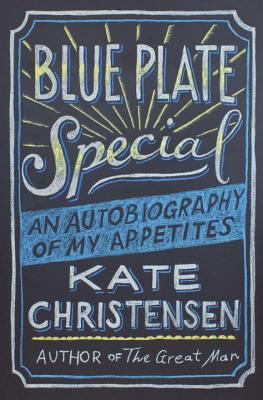
From acclaimed novelist Kate Christensen, Blue Plate Special is a mouthwatering literary memoir about an unusual upbringing and the long, winding path to happiness.“To
taste fully is to live fully.” For Kate Christensen, food and eating
have always been powerful connectors to self and world—“a subterranean
conduit to sensuality, memory, desire.” Her appetites run deep; in her
own words, she spent much of her life as “a hungry, lonely, wild animal
looking for happiness and stability.” Now, having found them at last, in
this passionate feast of a memoir she reflects upon her journey of
innocence lost and wisdom gained, mistakes made and lessons learned, and
hearts broken and mended.
In the tradition of M. F. K. Fisher, Laurie Colwin, and Ruth Reichl,
Blue Plate Special is
a narrative in which food—eating it, cooking it, reflecting on
it—becomes the vehicle for unpacking a life. Christensen explores her
history of hunger—not just for food but for love and confidence and a
sense of belonging—with a profound honesty, starting with her unorthodox
childhood in 1960s Berkeley as the daughter of a mercurial legal
activist who ruled the house with his fists. After a whirlwind
adolescent awakening, Christensen strikes out to chart her own destiny
within the literary world and the world of men, both equally alluring
and dangerous. Food of all kinds, from Ho Hos to haute cuisine, remains
an evocative constant throughout, not just as sustenance but as a realm
of experience unto itself, always reflective of what is going on in her
life. She unearths memories—sometimes joyful, sometimes painful—of the
love between mother and daughter, sister and sister, and husband and
wife, and of the times when the bonds of love were broken. Food sustains
her as she endures the pain of these ruptures and fuels her
determination not to settle for anything less than the love and
contentment for which she’s always yearned.
The physical and emotional sensuality that defines Christensen’s fiction resonates throughout the pages of
Blue Plate Special.
A vibrant celebration of life in all its truth and complexity, this
book is about embracing the world through the transformative power of
food: it’s about listening to your appetites, about having faith, and
about learning what is worth holding on to and what is not.
Listen to the NPR interview with the author HERE.
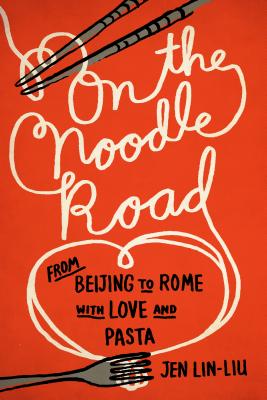
A food writer travels the Silk Road, immersing herself in a moveable
feast of foods and cultures and discovering some surprising truths about
commitment, independence, and love.Feasting her way through
an Italian honeymoon, Jen Lin-Liu was struck by culinary echoes of the
delicacies she ate and cooked back in China, where she’d lived for more
than a decade.
Who really invented the noodle? she wondered, like
many before her. But also: How had food and culture moved along the
Silk Road, the ancient trade route linking Asia to Europe—and what could
still be felt of those long-ago migrations? With her new husband’s
blessing, she set out to discover the connections, both historical and
personal, eating a path through western China and on into Central Asia,
Iran, Turkey, and across the Mediterranean.
The journey takes
Lin-Liu into the private kitchens where the headscarves come off and
women not only knead and simmer but also confess and confide. The thin
rounds of dough stuffed with meat that are dumplings in Beijing evolve
into
manti in Turkey—their tiny size the measure of a bride’s
worth—and end as tortellini in Italy. And as she stirs and samples,
listening to the women talk about their lives and longings, Lin-Liu
gains a new appreciation of her own marriage, learning to savor the
sweetness of love freely chosen.
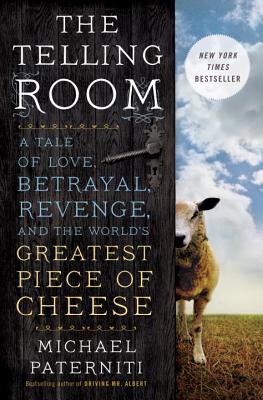
In the picturesque village of Guzmán, Spain, in a cave dug into a
hillside on the edge of town, an ancient door leads to a cramped
limestone chamber known as “the telling room.” Containing nothing but a
wooden table and two benches, this is where villagers have gathered for
centuries to share their stories and secrets—usually accompanied by
copious amounts of wine.
It was here, in the summer of 2000,
that Michael Paterniti found himself listening to a larger-than-life
Spanish cheesemaker named Ambrosio Molinos de las Heras as he spun an
odd and compelling tale about a piece of cheese. An unusual piece of
cheese. Made from an old family recipe, Ambrosio’s cheese was reputed to
be among the finest in the world, and was said to hold mystical
qualities. Eating it, some claimed, conjured long-lost memories. But
then, Ambrosio said, things had gone horribly wrong. . . .
By
the time the two men exited the telling room that evening, Paterniti was
hooked. Soon he was fully embroiled in village life, relocating his
young family to Guzmán in order to chase the truth about this cheese and
explore the fairy tale–like place where the villagers conversed with
farm animals, lived by an ancient Castilian code of honor, and made
their wine and food by hand, from the grapes growing on a nearby hill
and the flocks of sheep floating over the Meseta.
What
Paterniti ultimately discovers there in the highlands of Castile is
nothing like the idyllic slow-food fable he first imagined. Instead,
he’s sucked into the heart of an unfolding mystery, a blood feud that
includes accusations of betrayal and theft, death threats, and a murder
plot. As the village begins to spill its long-held secrets, Paterniti
finds himself implicated in the very story he is writing.
Equal parts mystery and memoir, travelogue and history,
The Telling Room is
an astonishing work of literary nonfiction by one of our most
accomplished storytellers. A moving exploration of happiness,
friendship, and betrayal,
The Telling Room introduces us to
Ambrosio Molinos de las Heras, an unforgettable real-life literary hero,
while also holding a mirror up to the world, fully alive to the power
of stories that define and sustain us.