Showing posts with label tattered cover recommendations science. Show all posts

Monday, February 24, 2014

"Arresting . . . Ms. Kolbert shows in these pages that she can write with elegiac poetry about the vanishing creatures of this planet, but the real power of her book resides in the hard science and historical context she delivers here, documenting the mounting losses that human beings are leaving in their wake." —The New York Times

http://bit.ly/1fkabrA

A major book about the future of the world, blending intellectual and natural history and field reporting into a powerful account of the mass extinction unfolding before our eyes

Over the last half a billion years, there have been five mass extinctions, when the diversity of life on earth suddenly and dramatically contracted. Scientists around the world are currently monitoring the sixth extinction, predicted to be the most devastating extinction event since the asteroid impact that wiped out the dinosaurs. This time around, the cataclysm is us. In The Sixth Extinction, two-time winner of the National Magazine Award and New Yorker writer Elizabeth Kolbert draws on the work of scores of researchers in half a dozen disciplines, accompanying many of them into the field: geologists who study deep ocean cores, botanists who follow the tree line as it climbs up the Andes, marine biologists who dive off the Great Barrier Reef. She introduces us to a dozen species, some already gone, others facing extinction, including the Panamian golden frog, staghorn coral, the great auk, and the Sumatran rhino. Through these stories, Kolbert provides a moving account of the disappearances occurring all around us and traces the evolution of extinction as concept, from its first articulation by Georges Cuvier in revolutionary Paris up through the present day. The sixth extinction is likely to be mankind's most lasting legacy; as Kolbert observes, it compels us to rethink the fundamental question of what it means to be human.

Read an interview with the author HERE.

Read an interesting conversation between the author and her editor HERE.

Saturday, January 19, 2013

“With engaging storytelling skill and deep scientific knowledge, Streever offers a fascinating exploration of one of the basic necessities of everyday life.” — Booklist


An adventurous ride through the most blisteringly hot regions of science, history, and culture.

Melting glaciers, warming oceans, droughts-it's clear that today's world is getting hotter. But while we know the agony of a sunburn or the comfort of our winter heaters, do we really understand heat?

A bestselling scientist and nature writer who goes to any extreme to uncover the answers, Bill Streever sets off to find out what heat really means. Let him be your guide and you'll firewalk across hot coals and sweat it out in Death Valley, experience intense fever and fire, learn about the invention of matches and the chemistry of cooking, drink crude oil, and explore thermonuclear weapons and the hottest moment of all time-the big bang.

Written in Streever's signature spare and refreshing prose, Heat is an adventurous personal narrative that leaves readers with a new vision of an everyday experience-how heat works, its history, and its relationship to daily life.

Listen to the NPR piece about the book HERE.


Sunday, January 13, 2013

What We Have In Common With Rocks and Planets


From one of our finest and most popular science writers, and the best-selling author of  Your Inner Fish, comes the answer to a scientific mystery as big as the world itself: How are the events that formed our solar system billions of years ago embedded inside each of us?

In Your Inner Fish, Neil Shubin delved into the amazing connections between human bodies—our hands, heads, and jaws—and the structures in fish and worms that lived hundreds of millions of years ago. In The Universe Within, with his trademark clarity and exuberance, Shubin takes an even more expansive approach to the question of why we look the way we do. Starting once again with fossils, he turns his gaze skyward, showing us how the entirety of the universe’s fourteen-billion-year history can be seen in our bodies. As he moves from our very molecular composition (a result of stellar events at the origin of our solar system) through the workings of our eyes, Shubin makes clear how the evolution of the cosmos has profoundly marked our own bodies.

Thursday, July 28, 2011

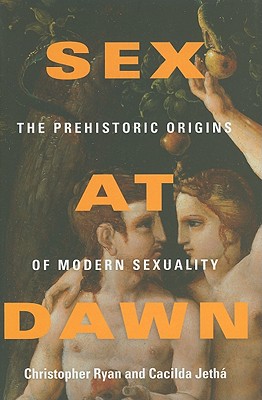
A New Theory About Human Sexuality

Since Darwin's day, we've been told that sexual monogamy comes naturally to our species. Mainstream science—as well as religious and cultural institutions—has maintained that men and women evolved in families in which a man's possessions and protection were exchanged for a woman's fertility and fidelity. But this narrative is collapsing. Fewer and fewer couples are getting married, and divorce rates keep climbing as adultery and flagging libido drag down even seemingly solid marriages.

How can reality be reconciled with the accepted narrative? It can't be, according to renegade thinkers Christopher Ryan and Cacilda Jetha. While debunking almost everything we "know" about sex, they offer a bold alternative explanation in this provocative and brilliant book.

Ryan and Jetha's central contention is that human beings evolved in egalitarian groups that shared food, child care, and, often, sexual partners. Weaving together convergent, frequently overlooked evidence from anthropology, archaeology, primatology, anatomy, and psychosexuality, the authors show how far from human nature monogamy really is. Human beings everywhere and in every era have confronted the same familiar, intimate situations in surprisingly different ways. The authors expose the ancient roots of human sexuality while pointing toward a more optimistic future illuminated by our innate capacities for love, cooperation, and generosity.


With intelligence, humor, and wonder, Ryan and JethÃ… show how our promiscuous past haunts our struggles over monogamy, sexual orientation, and family dynamics. They explore why long-term fidelity can be so difficult for so many; why sexual passion tends to fade even as love deepens; why many middle-aged men risk everything for transient affairs with younger women; why homosexuality persists in the face of standard evolutionary logic; and what the human body reveals about the prehistoric origins of modern sexuality.

In the tradition of the best historical and scientific writing, Sex at Dawn unapologetically upends unwarranted assumptions and unfounded conclusions while offering a revolutionary understanding of why we live and love as we do.


Monday, May 16, 2011

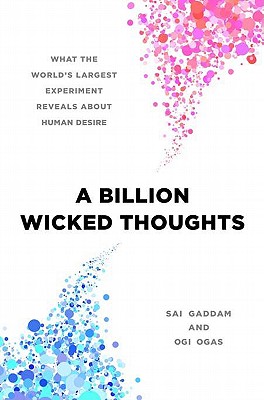
Results of the World's Largest Experiment!

A Billion Wicked Thoughts
Two maverick neuroscientists use the world's largest psychology experiment-the Internet-to study the private activities of millions of men and women around the world, unveiling a revolutionary and shocking new vision of human desire that overturns conventional thinking. 
 
For his groundbreaking sexual research, Alfred Kinsey and his team interviewed 18,000 people, relying on them to honestly report their most intimate experiences. Using the Internet, the neuroscientists Ogas and Gaddam quietly observed the raw sexual behaviors of half a billion people. By combining their observations with neuroscience and animal research, these two young neuroscientists finally answer the long-disputed question: what do people really like? Ogas and Gaddam's findings are transforming the way scientists and therapists think about sexual desire.


In their startling book, Ogas and Gaddam analyze a "billion wicked thoughts" on the Internet: a billion Web searches, a million individual search histories, a million erotic stories, a half-million erotic videos, a million Web sites, millions of online personal ads, and many other enormous sources of sexual data in order to understand the true differences between male and female desires, including:

*Men and women have hardwired sexual cues analogous to our hardwired tastes-there are sexual versions of sweet, sour, salty, savory, and bitter. But men and women are wired with different sets of cues.
*The male sexual brain resembles a reckless hunter, while the female sexual brain resembles a cautious detective agency.
*Men form their sexual interests during adolescence and rarely change. Women's sexual interests are plastic and change frequently.
*The male sexual brain is an "or gate": A single stimulus can arouse it. The female sexual brain is an "and gate": It requires many simultaneous stimuli to arouse it.
*When it comes to sexual arousal, men prefer overweight women to underweight women, and a significant number of men seek out erotic images of women in their 40s, 50s, and 60s.
*Women enjoy writing and sharing erotic stories with other women. The fastest growing genre of erotic stories for women are stories about two heterosexual men having sex.
*Though the male sexual brain is much more different from the female sexual brain than is commonly believed, the sexual brain of gay men is virtually identical to that of straight men.


Featuring cutting-edge, jaw-dropping science, this wildly entertaining and controversial book helps readers understand their partner's sexual desires with a depth of knowledge unavailable from any other source. Its fascinating and occasionally disturbing findings will rock our modern understanding of sexuality, just as Kinsey's reports did sixty years ago.

Wednesday, May 11, 2011

Jackie's Random Shelf Prowl Yielded THIS Find

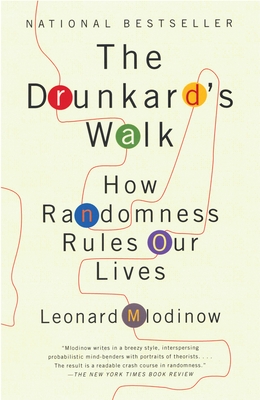
The Drunkard's Walk
With the born storyteller's command of narrative and imaginative approach, Leonard Mlodinow vividly demonstrates how our lives are profoundly informed by chance and randomness and how everything from wine ratings and corporate success to school grades and political polls are less reliable than we believe.

By showing us the true nature of chance and revealing the psychological illusions that cause us to misjudge the world around us, Mlodinow gives us the tools we need to make more informed decisions. From the classroom to the courtroom and from financial markets to supermarkets, Mlodinow's intriguing and illuminating look at how randomness, chance, and probability affect our daily lives will intrigue, awe, and inspire.


(Yes, the video is long, but it's FASCINATING!--Jackie)

Friday, April 15, 2011

This Book Will Put Your Head In The Clouds

The perfect incentive for keeping your head in the clouds, The Cloud Collector's Handbook is a whimsical guide to the wonders of the sky. Throughout, author and cloud expert Gavin Pretor-Pinney catalogs a variety of clouds and gives readers points for spotting them and recording their finds. This fun and useful book features gorgeous full-color photographs that showcase a new type of cloud on every spread, from fluffy cumulus to the super rare horseshoe vortex to the wispy noctilucent clouds that hang at the fringes of space. Sure to be a hit with both aspiring and seasoned cloud gazers, this clever handbook will have everyone looking up.

Tuesday, July 20, 2010

We Really ARE What We Eat

Why is eating chocolate so pleasurable? Can the function of just one small group of chemicals really determine whether you are happy or sad? Does marijuana help to improve your memory in old age? Is it really best to drink coffee if you want to wake up and be alert? Why is a drug like PCP potentially lethal? Why does drinking alcohol make you drowsy? Do cigarettes help to relieve anxiety? What should you consume if you are having trouble staying in your chair and focusing enough to get your work done? Why do treatments for the common cold make us drowsy? Can eating less food preserve your brain? What are the possible side effects of pills that claim to make your smarter? Why is it so hard to stop smoking? Why did witches once believe that they could fly?

In this book, Gary Wenk demonstrates how, as a result of their effects on certain neurotransmitters concerned with behavior, everything we put into our bodies has very direct consequences for how we think, feel, and act. The chapters introduce each of the main neurotransmitters involved with behavior, discuss its role in the brain, present some background on how it is generally turned on and off, and explain ways to influence it through what we consume.