Showing posts with label tattered cover recommendations biography. Show all posts

Tuesday, December 2, 2014

More Than A Deep Thinker

http://bit.ly/1vzqLLg

The world knows Freud as a thinker--one of the founding giants of modern culture. Now Lydia Flem paints a unique and unforgettable portrait of Frued the man: a father, husband, and friend, a secular Jew with passion for classical antiquity and European culture, torn between his need to be fully accepted in an anitsemitic society while remaining fatihful to his orgins.

Flem enters into the depths of Freud's creativity, showing how his thinking is connected to his immersion in the arts, the history of religions, and mythology. The intimate details of his daily life, his relationships with women, his poetic gifts, his travels, his dreams, his letters to family, friends, and colleagues: all reveal his vision of the unconscious. We accompany Freud on his walks through Vienna and Rome; look over his shoulder as he writes to his fiancee; learn the significance of the Greek, Roman, and Egyptian figurines that stand before him on his desk as he conceives his groundbreaking ideas; and discover the books, read in childhood, that later shape his self-analysis and his theoretical development.

Flem draws on an unusually broad range of sources, but she wears her learning lightly: her biography of Freud reads like a novel, full of vivid details and captivating human interest. From the 6-year-old gleefully tearing up a book illustrated with pictures of Persia; to the young doctor balancing his scientific training with his love of Shakespeare; to the psychoanalyst in his prime, conquering the resistance to his theories; to the old man, ravaged by illness, forced to flee into exile in England, Lydia Flem leads us deep into the life of a genius.

Sunday, February 2, 2014

“[An] eye-opening biography of the would-be political kingmaker and Fox News mastermind . . . A well-reported, engaging book. A bonus: Bill O’Reilly won’t like it, either. Politics and media junkies, on the other hand, will have a field day.”—Kirkus Reviews

http://bit.ly/1cjyaGf


When Rupert Murdoch enlisted Roger Ailes to launch a cable news network in 1996, American politics and media changed forever. Now, with a remarkable level of detail and insight, New York magazine reporter Gabriel Sherman brings Ailes’s unique genius to life, along with the outsize personalities—Bill O’Reilly, Sean Hannity, Megyn Kelly, Sarah Palin, Karl Rove, Glenn Beck, Mike Huckabee, and others—who have helped Fox News play a defining role in the great social and political controversies of the past two decades. From the Clinton-Lewinsky scandal to the Bush-Gore recount, from the war in Iraq to the Tea Party attack on the Obama presidency, Roger Ailes has developed an unrivaled power to sway the national agenda. Even more, he has become the indispensable figure in conservative America and the man any Republican politician with presidential aspirations must court.

How did this man, whose life story has until now been shrouded in myth, become the master strategist of our political landscape? In revelatory detail, Sherman chronicles the rise of Ailes, a sickly kid from an Ohio factory town who, through sheer willpower, the flair of a showman, fierce corporate politicking, and a profound understanding of the priorities of middle America, built the most influential television news empire of our time.

Drawing on hundreds of interviews with Fox News insiders past and present, Sherman documents Ailes’s tactical acuity as he battles the press, business rivals, and countless real and perceived enemies inside and outside Fox. Sherman takes us inside the morning meetings in which Ailes and other high-level executives strategize Fox’s presentation of the news to advance Ailes’s political agenda; provides behind-the-scenes details of Ailes’s crucial role as finder and shaper of talent, including his sometimes rocky relationships with Fox News stars such as O’Reilly and Hannity; and probes Ailes’s fraught partnership with his equally brash and mercurial boss, Rupert Murdoch.

Roger Ailes’s life is a story worthy of Citizen Kane. The Loudest Voice in the Room is an extraordinary feat of reportage with a compelling human drama at its heart.


Saturday, November 16, 2013

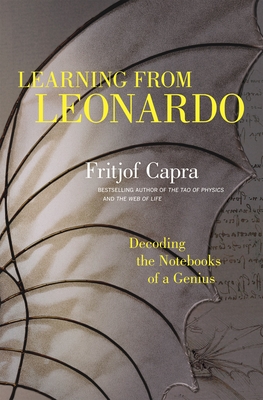
“This remarkable exposition of Leonardo’s work provides in analysis and illustration not only the nature of genius but the intellectual epic that can unfold whenever the human mind is set free.” ~ E.O. Wilson


Leonardo da Vinci was a brilliant artist, scientist, engineer, mathematician, architect, inventor, and even musician ;the archetypal Renaissance man. But he was also a profoundly modern man.

Not only did Leonardo invent the empirical scientific method over a century before Galileo and Francis Bacon, but Capra's decade-long study of Leonardo's fabled notebooks reveals that he was a systems thinker centuries before the term was coined. At the very core of Leonardo's science, Capra argues, lies his persistent quest for understanding the nature of life. His science is a science of living forms, of qualities and patterns, radically different from the mechanistic science that emerged 200 years later.

Because he saw the world as an integrated whole, Leonardo always applied concepts from one area to illuminate problems in another. His studies of the movement of water informed his ideas about how landscapes are shaped, how sap rises in plants, how air moves over a birds wing, and how blood flows in the human body. His observations of nature enhanced his art, his drawings were integral to his scientific studies, and he brought art, science, and technology together in his beautiful and elegant mechanical and architectural designs.

Capra describes seven defining characteristics of Leonardo da Vinci's genius and includes a list of over forty discoveries he made that weren't rediscovered until centuries later. Capra follows the organizational scheme Leonardo himself intended to use if he ever published his notebooks. So in a sense, this is Leonardo's science as he himself would have presented it.

Obviously, we cant all be geniuses on the scale of Leonardo da Vinci. But his persistent endeavor to put life at the very center of his art, science, and design and his recognition that all natural phenomena are fundamentally interconnected and interdependent are important lessons we can learn from. By exploring the mind of the preeminent Renaissance genius, we can gain profound insights into how to address the complex challenges of the 21st century.

Monday, November 4, 2013

“As raw and real and stream-of-consciousness as one of Pryor's routines.” --Patton Oswalt, comedian

http://bit.ly/16WNM1z

Richard Pryor was arguably the single most influential performer of the second half of the twentieth century, and certainly he was the most successful black actor/comedian ever. Controversial and somewhat enigmatic in his lifetime, Pryor s performances opened up a new world of possibilities, merging fantasy with angry reality in a way that wasn't just new it was heretofore unthinkable.

His childhood in Peoria, Illinois, was spent just trying to survive. Yet the culture into which Richard Pryor was born his mother was a prostitute; his grandmother ran the whorehouse helped him evolve into one of the most innovative and outspoken performers ever, a man who attracted admiration and anger in equal parts. Both a brilliant comedian and a very astute judge of what he could get away with, Pryor was always pushing the envelope, combining anger and pathos, outrage and humor, into an art form, laying the groundwork for the generations of comedians who followed, including such outstanding performers as Eddie Murphy, Chris Rock, and Louis C.K.

Now, in this groundbreaking and revelatory work, Joe and David Henry bring him to life both as a man and as an artist, providing an in-depth appreciation of his talent and his lasting influence, as well as an insightful examination of the world he lived in and the influences that shaped both his persona and his art.

Read an excerpt HERE.

Tuesday, September 24, 2013

New Biographies On Our Shelves

From Graham Nash—the legendary musician and founding member of the iconic bands Crosby, Stills & Nash and The Hollies—comes a candid and riveting autobiography that belongs on the reading list of every classic rock fan.

Graham Nash's songs defined a generation and helped shape the history of rock and roll—he’s written over 200 songs, including such classic hits as "Carrie Anne," “On A Carousel,” "Simple Man," "Our House," “Marrakesh Express,” and "Teach Your Children." From the opening salvos of the British Rock Revolution to the last shudders of Woodstock, he has rocked and rolled wherever music mattered. Now Graham is ready to tell his story: his lower-class childhood in post-war England, his early days in the British Invasion group The Hollies; becoming the lover and muse of Joni Mitchell during the halcyon years, when both produced their most introspective and important work; meeting Stephen Stills and David Crosby and reaching superstardom with Crosby, Stills, Nash & Young; and his enduring career as a solo musician and political activist.  Nash has valuable insights into a world and time many think they know from the outside but few have experienced at its epicenter, and equally wonderful anecdotes about the people around him: the Beatles, the Stones, Hendrix, Cass Elliot, Dylan, and other rock luminaries. From London to Laurel Canyon and beyond, Wild Tales is a revealing look back at an extraordinary life—with all the highs and the lows; the love, the sex, and the jealousy; the politics; the drugs; the insanity—and the sanity—of a magical era of music.


Julian Barnes, author of the Man Booker Prize–winning novel The Sense of an Ending, gives us his most powerfully moving book yet, beginning in the nineteenth century and leading seamlessly into an entirely personal account of loss—making Levels of Life an immediate classic on the subject of grief.

Levels of Life is a book about ballooning, photography, love and loss; about putting two things, and two people, together, and about tearing them apart. One of the judges who awarded Barnes the 2011 Booker Prize described him as “an unparalleled magus of the heart.” This book confirms that opinion.


For the first time ever—a comprehensive biography of one of the twentieth century’s most innovative creative artists: the incomparable, irreplaceable Jim Henson

He was a gentle dreamer whose genial bearded visage was recognized around the world, but most people got to know him only through the iconic characters born of his fertile imagination: Kermit the Frog, Bert and Ernie, Miss Piggy, Big Bird. The Muppets made Jim Henson a household name, but they were just part of his remarkable story.

This extraordinary biography—written with the generous cooperation of the Henson family—covers the full arc of Henson’s all-too-brief life: from his childhood in Leland, Mississippi, through the years of burgeoning fame in America, to the decade of international celebrity that preceded his untimely death at age fifty-three. Drawing on hundreds of hours of new interviews with Henson's family, friends, and closest collaborators, as well as unprecedented access to private family and company archives, Brian Jay Jones explores the creation of the Muppets, Henson’s contributions to Sesame Street and Saturday Night Live, and his nearly ten-year campaign to bring The Muppet Show to television. Jones provides the imaginative context for Henson’s non-Muppet projects, including the richly imagined worlds of The Dark Crystal and Labyrinth—as well as fascinating misfires like Henson’s dream of opening an inflatable psychedelic nightclub.

An uncommonly intimate portrait, Jim Henson captures all the facets of this American original: the master craftsman who revolutionized the presentation of puppets on television, the savvy businessman whose dealmaking prowess won him a reputation as “the new Walt Disney,” and the creative team leader whose collaborative ethos earned him the undying loyalty of everyone who worked for him. Here also is insight into Henson’s intensely private personal life: his Christian Science upbringing, his love of fast cars and expensive art, and his weakness for women. Though an optimist by nature, Henson was haunted by the notion that he would not have time to do all the things he wanted to do in life—a fear that his heartbreaking final hours would prove all too well founded.

An up-close look at the charmed life of a legend, Jim Henson gives the full measure to a man whose joyful genius transcended age, language, geography, and culture—and continues to beguile audiences worldwide.


Sunday, May 19, 2013

His Life in His Own Words


On March 13, 2013, the former Cardinal Jorge Mario Bergoglio, longtime Archbishop of Buenos Aires, now Pope Francis, was elected to succeed Pope Benedict.  He is the first Latin American pope, the first Jesuit pope, and the first to take the name Francis, after St. Francis Assisi, the 13th century monk known for his charity and kindness.

Elected in one of the shortest conclaves in history, the former Archbishop Jorge Mario Bergoglio of Argentina reveals, in a series of extensive interviews conducted over the course of two years, the very image of a humble priest, inspired teacher, and wise and adroit cardinal. What emerges is a portrait of a man more interested in substance over style, a compassionate cleric and teacher who has shunned the spotlight. In spontaneous, intimate terms, Archbishop Bergoglio, now Pope Francis, covers topics as wide-ranging as his childhood, family life, and the importance of his first job to discovering his calling and his early days in the seminary. The former archbishop was a teacher of psychology and literature until John Paul II consecrated him as a cardinal. He befriended writers like Jorge Luis Borges and cites Homer, Cervantes, and German and Italian poets with ease and offers nuanced thoughts about teaching. Thoughtful, intelligent, and even witty, he names Babette’s Feast as his favorite movie and Marc Chagall as his favorite painter.

A learned and introspective man, he does not avoid the uncomfortable subjects: the declining numbers of priests and nuns; celibacy; the sexual abuse scandals that have rocked the Church; and his opinions about and experience with the military dictatorship of his own crisis-riddled country. It also discusses the incredible role he played in the last conclave, where he is said to have been tied with Ratzinger in the second of three votes, and asked that the votes for him be transferred to Ratzinger.

Through his own words, we come to know a man whose actions and words reflect his deeply-rooted humility. The book concludes with the Pope’s own writings and reflections, full of wisdom and inspiration.

Friday, November 18, 2011

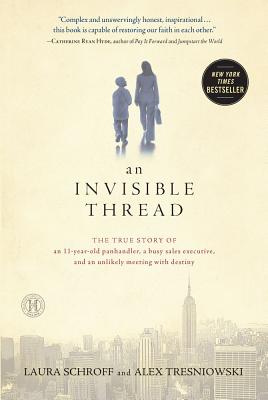
"An invisible thread connects those who are destined to meet, regardless of time, place, circumstance. The thread may stretch or tangle, but it will never break." --Ancient Chinese Proverb

Excuse me lady, do you have any spare change? I am hungry.”

When I heard him, I didn’t really hear him. His words were part of the clatter, like a car horn or someone yelling for a cab. They were, you could say, just noise—the kind of nuisance New Yorkers learn to tune out. So I walked right by him, as if he wasn’t there. 

But then, just a few yards past him, I stopped. 

And then—and I’m still not sure why I did this—I came back.

When Laura Schroff first met Maurice on a New York City street corner, she had no idea that she was standing on the brink of an incredible and unlikely friendship that would inevitably change both their lives. As one lunch at McDonald’s with Maurice turns into two, then into a weekly occurrence that is fast growing into an inexplicable connection, Laura learns heart-wrenching details about Maurice’s horrific childhood.


The boy is stuck in something like hell. He is six years old and covered in small red bites from chinches—bed bugs—and he is woefully skinny due to an unchecked case of ringworm. He is so hungry his stomach hurts, but then he is used to being hungry: when he was two years old the pangs got so bad he rooted through the trash and ate rat droppings. He had to have his stomach pumped. He is staying in his father’s cramped, filthy apartment, sleeping with stepbrothers who wet the bed, surviving in a place that smells like something died. He has not seen his mother in three months, and he doesn’t know why. His world is a world of drugs and violence and unrelenting chaos, and he has the wisdom to know, even at six, that if something does not change for him soon, he might not make it. 

Sprinkled throughout the book is also Laura’s own story of her turbulent childhood. Every now and then, something about Maurice's struggles reminds her of her past, how her father’s alcohol-induced rages shaped the person she became and, in a way, led her to Maurice.

He started by cursing my mother and screaming at her in front of all of us. My mother pulled us closer to her and waited for it to pass. But it didn’t. My father left the room and came back with two full liquor bottles. He threw them right over our heads, and they smashed against the wall. Liquor and glass rained down on us, and we pulled up the covers to shield ourselves. My father hurled the next bottle, and then went back for two more. They shattered just above our heads; the sound was sickening. My father kept screaming and ranting, worse than I’d ever heard him before. When he ran out of bottles he went into the kitchen and overturned the table and smashed the chairs. Just then the phone rang, and my mother rushed to get it. I heard her screaming to the caller to get help. My father grabbed the phone from her and ripped the base right out of the wall. My mother ran back to us as my father kept kicking and throwing furniture, unstoppable, out of his mind.
 
As their friendship grows, Laura offers Maurice simple experiences he comes to treasure: learning how to set a table, trimming a Christmas tree, visiting her nieces and nephew on Long Island, and even having homemade lunches to bring to school.

  
“If you make me lunch,” he said, “will you put it in a brown paper bag?”

I didn’t really understand the question. "Okay, sure. But why do you want it in a brown paper bag?”

“Because when I see kids come to school with their lunch in a brown paper bag, that means someone cares about them.” I looked away when Maurice said that, so he wouldn’t see me tear up. A simple brown paper bag, I thought.
 
To me, it meant nothing. To him, it was everything.

It is the heartwarming story of a friendship that has spanned thirty years, that brought life to an over-scheduled professional who had lost sight of family and happiness and hope to a hungry and desperate boy whose family background in drugs and crime and squalor seemed an inescapable fate.

He had, inside of him, some miraculous reserve of goodness and strength, some fierce will to be special. I saw this in his hopeful face the day he asked for spare change, and I see it in his eyes today. Whatever made me notice him on that street corner so many years ago is clearly something that cannot be extinguished, no matter how relentless the forces aligned against it. Some may call it spirit. Some might call it heart. Whatever it was, it drew me to him, as if we were bound by some invisible, unbreakable thread.

And whatever it is, it binds us still.


Jackie says:

"One day Laura Schroff, a busy ad exec, was walking down a street and barely registered a small boy ask her 'Excuse me, lady, do you have any spare change?'  But for some reason, a reason she couldn't name then or now, she turned around half way across the street, nearly getting hit by the impatient Manhattan drivers, went back to the boy and offered to take him to lunch at McDonalds.  In that moment a friendship was born that changed both of their lives forever.  They began an unlikely friendship that has lasted 25 years and is still going strong.  This is an amazing story of love and hope and how it can change lives, not just for two people, but potentially for an entire generation.  This is a rags to riches story of the soul and the heart, and I think everyone should read it--it could help you see the world very, very differently."

Monday, August 8, 2011

A Classic Biography Is Now Back In Print


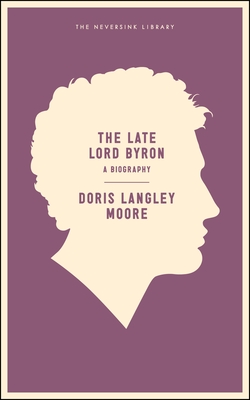
“The best biography of Lord Byron ever written,” according to Poet Laureate W. S. Merwin, is now back in print after decades.

Of the hundreds of books on Byron and his work, not one has been devoted to the immediate aftermath of his life; and yet it is these first twenty posthumous years that yield the most unexpected and exciting discoveries about the character of the poet and the behavior of those who once surrounded him—wife, sister, friends, enemies.

With the burning of his memoirs almost as soon as news of his death reach England in May 1924, there began the sequence of impassioned controversies that have followed one another like the links in a chain ever since. What sort of man was the begetter of these dramas? Unflagging in energy and acumen, Doris Lang- ley Moore sifts the various witnesses, their motives and credentials, and not only reveals how much questionable evidence has been accepted but develops a corrected picture that appeals and persuades.
   
Drawing upon a very large amount of unpublished material, from the Lovelace Papers, Murray manuscripts, and Hobhouse archives, she reaches the conclusion that, as to his chroniclers, a great man has too often fallen among thieves. The story she tells needs no special knowledge of Byron. It is written for everyone who enjoys literary detective work and human drama.


Tuesday, August 2, 2011

If You Think YOUR Family Is Complicated, Check Out Katharine Weber's


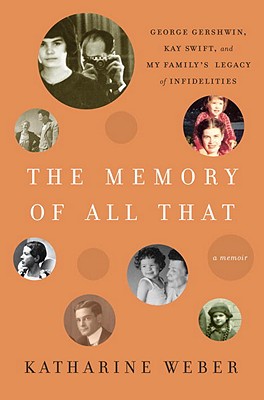
The Memory of All That is Katharine Weber’s memoir of her extraordinary family.

Her maternal grandmother, Kay Swift, was known both for her own music (she was the first woman to compose the score to a hit Broadway show, Fine and Dandy) and for her ten-year romance with George Gershwin. Their love affair began during Swift’s marriage to James Paul Warburg, the multitalented banker and economist who advised (and feuded with) FDR. Weber creates an intriguing and intimate group portrait of the renowned Warburg family, from her great-great-uncle, the eccentric art historian Aby Warburg, whose madness inspired modern theories of iconography, to her great-grandfather Paul M. Warburg, the architect of the Federal Reserve System whose unheeded warnings about the stock-market crash of 1929 made him “the Cassandra of Wall Street.”

As she throws new light on her beloved grandmother’s life and many amours, Weber also considers the role the psychoanalyst Gregory Zilboorg played in her family history, along with the ways the Warburg family has been as celebrated for its accomplishments as it has been vilified over the years by countless conspiracy theorists (from Henry Ford to Louis Farrakhan), who labeled Paul Warburg the ringleader of the so-called international Jewish banking conspiracy.

Her mother, Andrea Swift Warburg, married Sidney Kaufman, but their unlikely union, Weber believes, was a direct consequence of George Gershwin’s looming presence in the Warburg family. A notorious womanizer, Weber’s father was a peripatetic filmmaker who made propaganda and training films for the OSS during World War II before producing the first movie with smells, the regrettable flop that was AromaRama. He was as much an enigma to his daughter as he was to the FBI, which had him under surveillance for more than forty years, and even noted Katharine’s birth in a memo to J. Edgar Hoover.

Colorful, evocative, insightful, and very funny, The Memory of All That is an enthralling look at a tremendously influential—and highly eccentric—family, as well as a consideration of how their stories, with their myriad layers of truth and fiction, have both provoked and influenced one of our most prodigiously gifted writers.