Books and music go together, or at least Tattered Cover and our local indie music gurus at
Twist and Shout think

so. So we've decided to "borrow a cup of sugar" from each other from time to time, meaning we're sharing some of each other's reviews from our blogs (theirs is called
Twisted Spork ).
Now THAT Is What I'm Talkin' About!!
Explaining one’s love of The Grateful Dead is a complicated thing. Most folks who are unacquainted with the Dead are hopelessly misdirected by members of the music press, who have traditionally used the band and its fans as target practice, and the latter-day fans themselves who have not done the band’s reputation any favors. Contrary to this inaccurate reputation, The Grateful Dead (especially in the early days) were unlike any other band in that they encompassed almost every form of popular music, made it their own, and took it a step further by creating their own unique brand of music and performance style, and they did so with a high degree of musical proficiency as well as a fairly lofty attitude toward the art they were creating. They then sustained their organization for nearly thirty years with the same core group - an amazing feat in and of itself. In my judgment things changed pretty dramatically somewhere in the mid to late 70’s when their experimental, almost avant-garde aspirations slowly morphed into a highly competent and fun “rock show.” Great fun, but the sense that the creative lives of the band hung in the balance every night was replaced by a more tried and true form of show-biz. They went from being experimental to being reliable - which was understandable, even admirable, but to my ears far less exciting. I had many of the best times of my life at Dead shows in those latter years, but now, when I want to dig the Dead, I go old.

Thus I was thrilled to see one of my favorite shows and earliest collecting gems being officially released in its entirety in unbelievable sound quality.
Road Trips Volume 3 Number 3 actually comprises two shows played on the same night on May 15, 1970. Each show had an acoustic set, a set by the New Riders Of The Purple Sage (featuring members of the Dead but not included here) and then an electric set. These two shows beautifully illustrate what I was referencing above about the band encompassing many forms of music. Here is why it is hard to explain the Dead to others - they are an acoustic band, able to coax unbelievably delicate and sweet performances with the power of their harmonies and a handful of great songs; they are a rock band playing party faves like “Casey Jones”; they are a roots band with an authentic dog-suckin’ drunken blues singer, and a banjo playing bluegrass freak as two of their members; they are an experimental art-rock band making some of the darkest, weirdest, and most exhilarating improvised music ever performed and hardest to explain; they are a cultural phenomenon that, to many, was a neat representation of the excitement and turmoil of the 1960’s. Wow - that is a lot to hang on one band. This is the rap on the band, and when a lot of newcomers listen to a show from 1987, they don’t hear it. I would direct newcomers to this new
Road Trips for a good example of all the sides of The Grateful Dead. Containing two full acoustic sets and two long electric sets the first disc finds the band playing rare and new (at the time) songs like “Long Black Limousine,” “Ain’t it Crazy” and a stellar early version of “New Speedway Boogie.” The first electric set was one of my earliest tape acquisitions and has always been a favorite. The triple threat of “St. Stephen,” “The Other One” and the rarely played (and even more rarely played correctly) “Cosmic Charlie” is fiery, energetic and full of high energy jamming. “The Other One” in particular is thundering and intense. The encore of the early show is one of my favorite Bob Weir performances ever; a completely over-the-top, scream-fest of “New Minglewood Blues.” You’ve never heard a version like this one. The second acoustic set is highlighted by another bunch of rare and new acoustic performances. “The Ballad Of Casey Jones,” “Silver Threads and Golden Needles,” Pigpen’s “She’s Mine” and “Katie Mae” are all little heard treats and the performances of “Friend Of The Devil” and “Uncle John’s Band” just sparkle. The final electric set is a monster as well with a deep and mysterious “Dark Star” and a nearly 30 minute “Lovelight” that really showcases Pigpen’s singular talents and the band’s uncanny ability to follow him into any lascivious alley he ambled down. After years (nearly 40) of listening obsessively to The Grateful Dead I have changed my opinions about them, and become alternately more critical and forgiving. Mostly I have figured out what still gets me off about them - and this four–disc set (includes a killer bonus disc with the remainders of this show - a heartbreaking “Attics Of My Life” - and a big piece of the previous night’s show) is a pristine example of the Dead in the heart of their greatest period.
So, I know the amount of Grateful Dead stuff out there seems overwhelming. As long as I’m warmed up I think I will recommend another five of the best vault releases:
Carousel Ballroom 2-14-68 (
Road Trips Vol.2 No. 2)
Completely essential early radio broadcast. This Valentine’s Day show captures the band revved up and positively tearing through their early repertoire with abandon. The second half features a rip-roaring trip through “The Other One,” “New Potato Caboose,” “Born Cross Eyed,” “Alligator” and “Caution” landing in a heap of squealing feedback that is as scary as it is beautiful.
Englishtown, N.J. 9-3-77 (
Dick’s Picks Volume 15)
One of the best post-75 shows it contains definitive versions of “Mississippi Half-Step,” “Loser,” “The Music Never Stopped,” “Not Fade Away” and an “Eyes of The World” that defies description. Jerry plays solos on “Eyes” that sound like a cross between Wes Montgomery, Django Reinhardt and well… Jerry. Absolutely unforgettable!
Syracuse, N.Y. 9-28-76 (with 9-25-76 it makes up
Dick’s Picks Volume 20)
1976 was a pivotal year in many ways for the band. They were reinventing themselves with new songs and a new style of playing that was much more rehearsed and jazzy but still loose and filled with surprises. A seamless second set finds them moving effortlessly from Space (“Playin’ In The Band”) to Gospel (“Samson and Delilah”) to the best of Jerry’s ballads (“Comes a Time”) to free form exploration (“Orange Tango Jam”) to disco (“Dancin’ In The Streets”) and back again. They travel universes in the span of an hour.

illmore East 2-13 and 14-1970 (
Dick’s Picks Volume 4)
If push came to shove and I had to take just one Grateful Dead release with me into outer space this would be it. It’s got the finest example of spine-chilling Grateful Dead improv I can think of. The hour and a half that make up “Dark Star,” “The Other One” and “Lovelight” is as good as it gets. They do the seemingly impossible when they go out as far as you can go and still seem to be completely in control. The “Dark Star” moves through passages of incredible beauty, joy, terror and just plain weirdness that never fail to leave me breathless. It is probably my single favorite passage of Grateful Dead music.
Binghamton, N.Y. May 2, 1970 (
Dick’s Picks Volume 8)
This is the spiritual cousin to the 5-15-70 show reviewed above. Again it features both acoustic and electric sets, but it has a rough and ready quality that makes it unlike anything else. If I was forced to guess I would say the mystery element is LSD. The band sound high as kites and they, and the audience, are having the time of their lives. They are cracking jokes and bantering throughout the interesting and spirited first set (which includes some extremely unique arrangements of songs), and then they are clearly still in a great mood as they take the stage for a second half for the ages. The versions of “St. Stephen,” “The Other One” and “Good Lovin’” are orgies of outta control guitar playing, and in the final portion of the show they bust out elongated versions of “It’s A Man’s Man’s World,” “Dancin’ In The Streets” and finally “Viola Lee Blues” that are nothing short of cosmic. It is rumored that the band hung out at the dorms of Harpur College before and after this show hanging out with students, and that makes sense because, more than anything, this sounds like one big par-tay.
--Paul
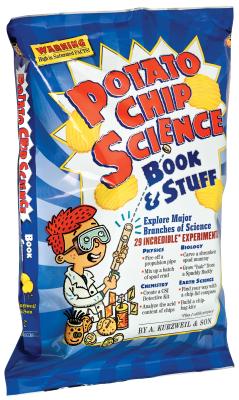 Pure genius, and the kind of idea that comes along once in a decade. "Potato Chip Science "is the book and kit that's an irresistible introduction to the pleasure of science for 8- to 12-year-olds. Here are 29 incredible experiments-plus one edible project-that use potato chips, potatoes, potato chip bags, tubes, and lids. Like" Pop Bottle Science" and "Bones Book and Skeleton," it's a book-with-stuff that is alive with possibilities, merging creative fun, and completely safe activities, with lessons drawn from ecology, biology, forensics, acoustics, aeronautics, optics, and more. All packaged inside a potato chip bag.